

Somewhere in the last three years NAD+ stopped being a line in a biochemistry textbook and became a number people compare. There are drip clinics, at-home tests that quote a blood NAD+ reading back with a percentile attached, and a precursor aisle that didn’t exist in 2015.
The biochemistry underneath all of that is genuinely good. It’s also, almost always, not the thing being sold.
Two things worth separating before anything else
NAD+ is not a peptide. It gets catalogued next to peptides and argued about in the same forums, but structurally it’s a dinucleotide: two nucleotides joined through their phosphates, no amino acids, no peptide bond anywhere. That grouping is commercial, not chemical.
The second separation is legal, and it trips up more writers. Most of the consumer NAD+ conversation is not about NAD+ at all. It’s about precursors, mainly nicotinamide riboside and nicotinamide mononucleotide, which are sold as dietary supplements and live under that category’s rules. FDA spent three years holding that NMN was excluded from the dietary supplement definition because it had been investigated as a drug first, then reversed in September 2025 and confirmed it is not excluded, while still requiring a new dietary ingredient notification. Research-grade NAD+ material sold into laboratories is a third thing again, in a different regulatory box from either. Three categories, one word, endless confusion.
A carrier, not a fuel
Here’s the reframe that makes the rest of this legible. NAD+ is not burned.
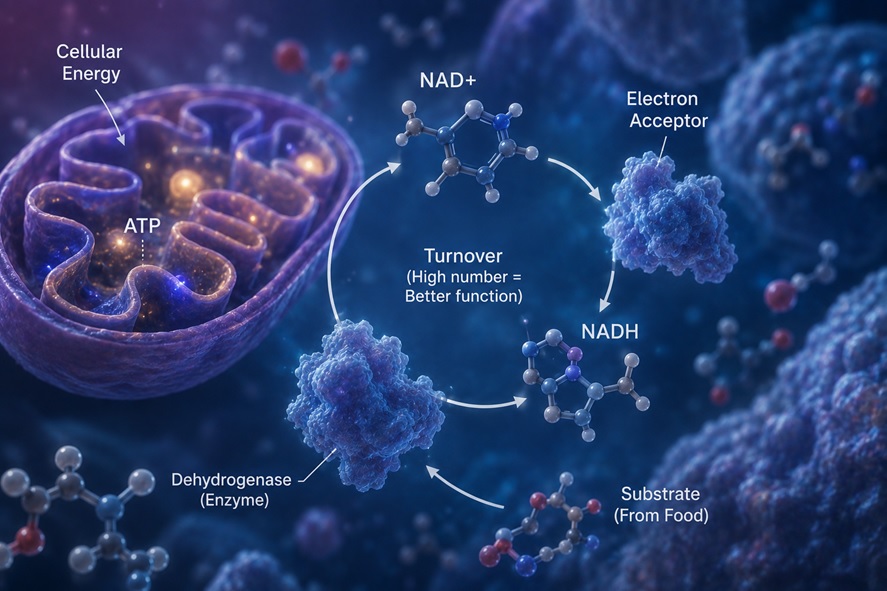
In its redox job it accepts a hydride from glycolysis, the TCA cycle or fatty acid oxidation, becomes NADH, delivers the electrons to the respiratory chain, and comes back as NAD+. Same molecule, returned to the depot. Nothing is consumed. When oxygen is short and lactate dehydrogenase pushes pyruvate to lactate, that reaction largely exists to regenerate NAD+ so glycolysis can keep moving.
So the cell isn’t hoarding fuel. It runs a courier service, and a small fleet moves enormous freight provided the round trip is quick. Concentration counts the couriers.
What actually destroys it
Three enzyme families spend NAD+ rather than borrow it: sirtuins, PARPs, and the NADases, chiefly CD38 and SARM1. Each of them cleaves the glycosidic bond, keeps the ADP-ribose portion for its own chemistry, and throws off nicotinamide as waste. One molecule of NAD+ per reaction, destroyed.
That asymmetry is the whole architecture. Redox work is free. Signalling work costs inventory, and the bill has to be paid continuously.
The salvage pathway, and a bottleneck with a name
Which is why the discarded nicotinamide gets collected. NAMPT bolts a phosphoribosyl group onto it to make NMN, NMNAT adds an adenylyl group, and the molecule is NAD+ again. That loop is the salvage pathway, and NAMPT is its rate-limiting step, partly through sheer affinity: it captures nicotinamide at submicromolar concentrations, while NNMT, the enzyme that methylates nicotinamide for disposal, needs concentrations a few hundred times higher.
Salvage wins by default.
How fast is the loop? Isotope tracing in mice found NAD turnover half-times spanning roughly fiftyfold across tissues, quickest in small intestine and spleen, slowest in skeletal muscle, with cultured cells sitting around six to twelve hours and primary hepatocytes closer to two. The same work showed the liver builds nicotinamide and exports it while most other tissues run on what’s already circulating.
Flux, in other words, is the quantity that matters, and it’s exactly what a static reading can’t report. That gap is much of why pure NAD+ exists as a laboratory reference material. Suppliers such as Peptides.com list it for research use with certificates of analysis attached, because the buyers are running enzyme assays where the readout is a rate rather than a concentration. Stated flatly, because the line gets blurred constantly: that’s a laboratory input, not a consumer product, and nearly all the mechanistic literature behind it is preclinical, in cell culture and animal models.
Sirtuins are the reason this field exists at all
Sirtuins are where the two halves of the story meet. In 2000, Imai and colleagues reported in Nature that Sir2, the yeast silencing protein already tied to lifespan, is an NAD-dependent histone deacetylase. Not NAD-using. NAD-consuming, stoichiometrically, one cofactor per reaction.
That distinction is load-bearing. A deacetylase that merely requires a cofactor is an enzyme. A deacetylase that destroys a central metabolic cofactor every time it fires is a sensor, its rate coupled to how much NAD+ the cell can afford to lose. Metabolic state reaches chromatin directly. Layer on the feedback, since the nicotinamide released inhibits sirtuins, and there’s a plausible route from fasting, exertion and energy stress to gene regulation. Every large claim ever made about NAD+ and aging runs back through that one piece of architecture.
CD38 muddies the picture usefully. Its levels and activity climb with age in mice, and it’s an aggressive NAD+ consumer, which points at age-related decline being partly a demand problem rather than a supply problem. Topping up the tank doesn’t fix a leak.
Where the human evidence actually sits
This is the part most coverage skips, and it deserves saying plainly.
Precursor trials do work, in a narrow sense. Six weeks of nicotinamide riboside raised NAD+ in peripheral blood mononuclear cells by roughly 60% in adults aged 55 to 79, and that trial’s stated primary finding was tolerability and NAD+ elevation, with the blood-pressure signal exploratory and not significant after correction. Three weeks in men with a median age of 75 more than doubled blood NAD+ and lifted the muscle NAD+ metabolome, yet muscle mitochondrial respiration, grip strength, glucose tolerance and body weight all sat unchanged. A 2025 systematic review pooling ten randomised trials of NMN and nicotinamide riboside in older adults concluded that current evidence does not support either for preserving muscle mass and function.
The marker moves reliably. The outcomes, so far, mostly don’t. That’s not a scandal, it’s what an early field looks like when the biomarker is cheap and the physiology is expensive, and it’s a good reason to distrust any write-up that leads with the marker.
One aside, since biohacking and competitive sport overlap more than either community admits. WADA does not name NAD+ or its precursors on the Prohibited List, but the S0 non-approved substances category sweeps in any pharmacological substance lacking health-authority approval for human therapeutic use, and M2 separately bars intravenous infusions above 100 mL in 12 hours outside a hospital setting. Anyone in a tested pool should be asking their anti-doping authority rather than a blog.
None of this makes the biology less interesting. It makes the measurement look immature. What the enzymes respond to is a rate, sustained over time, inside tissues nobody is sampling, and the number in the blood tube is a shadow of it at best. The field gets interesting the day measurement catches up. Right now it’s ahead of the biology in confidence and well behind it in resolution.
